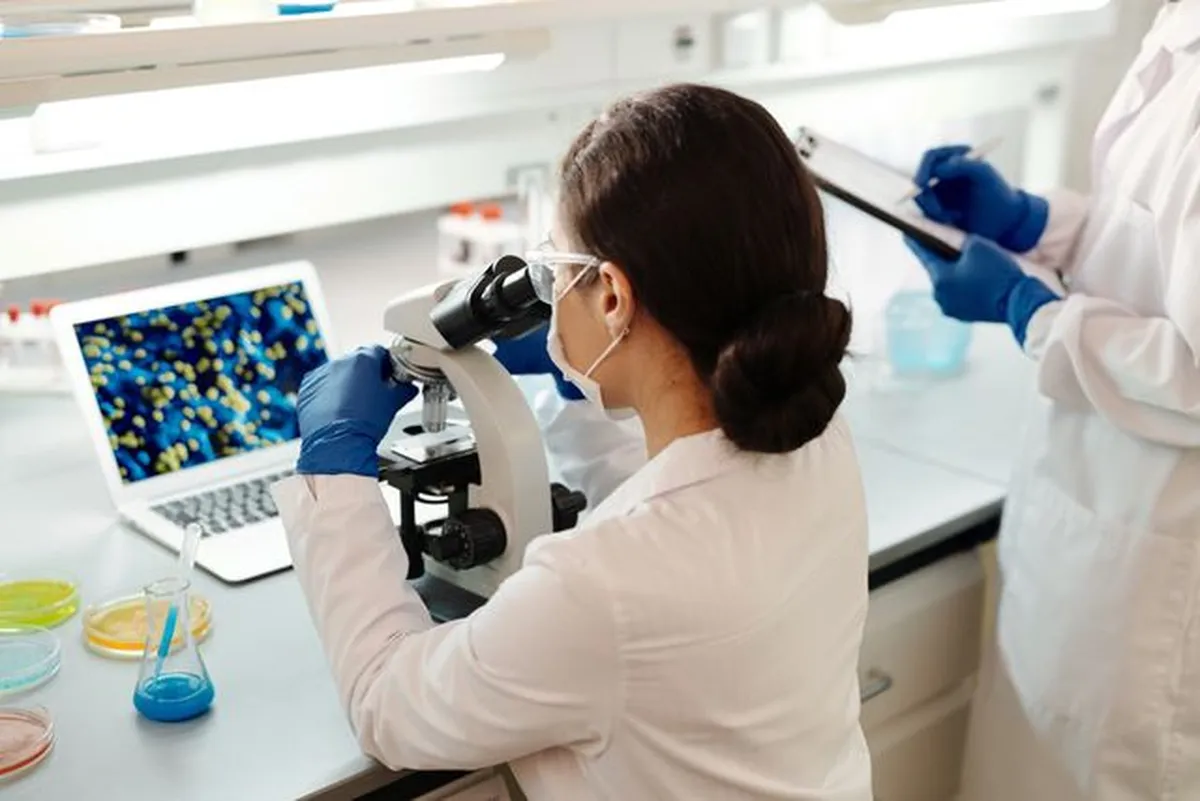
At the Ellison Institute of Technology (EIT), we’re on a mission to translate scientific discovery into real world impact. We bring together visionary scientists, technologists, engineers, researchers, educators and innovators to tackle humanity’s greatest challenges in four transformative areas:
- Health, Medical Science & Generative Biology
- Food Security & Sustainable Agriculture
- Climate Change & Managing CO₂
- Artificial Intelligence & Robotics
This is ambitious work - work that demands curiosity, courage, and a relentless drive to make a difference. At EIT, you’ll join a community built on excellence, innovation, tenacity, trust, and collaboration, where bold ideas become real-world breakthroughs. Together, we push boundaries, embrace complexity, and create solutions to scale ideas from lab to society. Explore more at www.eit.org.
Welcome to the Generative Biology Institute:
Led by Founding Director Jason Chin, the Generative Biology Institute (GBI) at the Ellison Institute of Technology is tackling the key challenges in making biology engineerable, and thereby unlocking the unrivalled power of biology for the benefit of humanity.
The vision of the GBI is to lay the foundations for engineering biology, and unlock its potential for good. To achieve this, we must overcome two key challenges. First, we need the ability to write in the natural language of biology, enabling the rapid and scalable synthesis of entire genomes with precision. Second, we must understand what to write - determining which DNA sequences will generate biological systems that perform the desired functions. Addressing these challenges will allow us to harness the full power of biology to create transformative solutions across health, agriculture, clean energy and more.
GBI will have sustained and substantial funding to support the unique scale and ambition of its ground-breaking vision for engineering biology. GBI researchers will also be supported by cutting-edge technology hubs including mass spectrometry, flow cytometry, sequencing, automation, imaging, and bioprocessing. GBI will also have access to substantial compute resources that can be leveraged to further accelerate progress, including scientific compute, bioinformatics, and machine learning. The environment at GBI will allow researchers to undertake ambitious, long-term, collaborative research, and we will actively support the translation of research to commercial applications, where appropriate.
The Generative Biology Institute commenced operations in 2025, occupying newly renovated bespoke space in the Oxford Science Park. The team will later move to a purpose-made facility in the Oxford Science Park, currently under construction. Once complete, this state-of-the-art facility will include more than 40,000 m² of research laboratory and office space. It will house over 30 groups and up to 600 employees at scale, focused on solving the two critical challenges in making biology engineerable and applying the solutions to addressing the global challenges encapsulated in EIT’s Humane Endeavors.
Your Role:
The Mass Spectrometry Tech Hub within the GBI is seeking a Scientist / Senior Scientist with expertise in single-cell mass spectrometry, with a particular focus on single-cell proteomics and/or metabolomics.
This is an exciting opportunity to help establish and develop cutting-edge single-cell MS workflows within a highly collaborative, technology-driven research institute. The successful candidate will work closely with GBI research groups as well as scientists across other EIT institutes. We also work in close collaboration with other Tech Hubs including automation, flow cytometry, sequencing, bioinformatics, scientific computing and AI/ML, to deliver high-quality, reproducible and scalable analytical workflows.
We are looking for candidates with a good understanding of the challenges of low-input and single-cell analysis, that can communicate clearly with multidisciplinary teams, can develop robust experimental workflows, and are motivated to push the boundaries of what mass spectrometry can deliver.
This role is particularly suited to a scientist who enjoys developing new methods, troubleshooting complex analytical workflows, working across biological applications, and translating advanced MS technologies into accessible, high-impact research capability for the wider Institute.
Key Responsibilities
- To develop, implement and optimise LC-MS-based workflows for low-input and single-cell proteomics and/or metabolomics.
- To support GBI, and broader EIT, researchers in the design, execution, analysis and interpretation of mass spectrometry experiments, including sample preparation, method development, data acquisition and data interpretation.
- To help develop standard operating procedures, training material and user-facing guidance for single-cell and low-input MS workflows.
- To contribute to the analysis and interpretation of complex MS datasets, working closely with bioinformatics, scientific computing and AI/ML colleagues where appropriate.
- To assist, where required, in manuscript preparation, internal reports and external presentations.
- To promote and champion EIT and the work of the GBI, representing the Institute at scientific meetings, conferences and public events where appropriate.